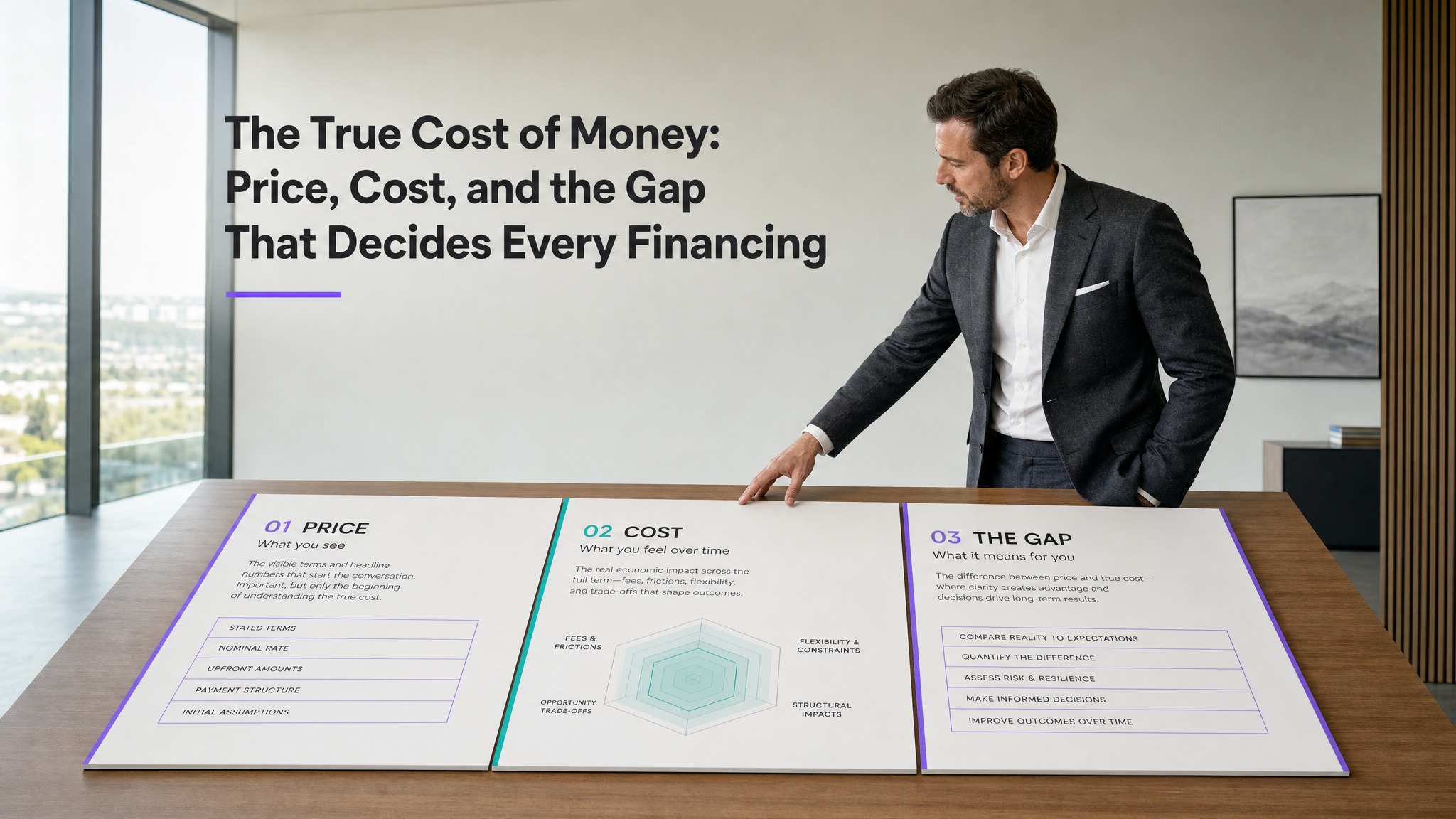
The True Cost of Money: Price, Cost, and the Gap That Decides Every Financing
The True Cost of Money: Price, Cost, and the Gap That Decides Every Financing
The True Cost of Money | The Complete Framework
Every business that borrows pays a rate, and almost every business decides on that rate as if it were the whole story. It is not. The rate is the price of money. It is not the cost. The two are different things, they routinely diverge, and the gap between them is where most capital decisions go wrong.
This is the framework in full. It runs across three parts, and each part goes deep on one facet: where the price comes from, why the price is not the cost, and what the difference looks like when a real business must choose among real alternatives. This piece states the whole argument and shows how the parts fit together, so a reader can see the entire logic in one place before deciding where to go deeper.
Key Points
The rate on a term sheet is the price of money, set largely by a business's position in the lending chain. It is not the cost of money, which is what the capital does to the business once it is inside.
Two businesses offered the identical rate can experience entirely different true costs, because the true cost depends on how fast the capital works and what it protects or forfeits, not on the number quoted.
The true cost of money has three parts: the financing cost measured per operating cycle, the opportunity cost of what the committed capital forgoes, and the operational impact on the business's cash engine. The rate captures only the first, and only partially.
A single variable governs all three: how fast a deployed dollar completes the loop from commitment back to cash. Faster capital costs less to carry, frees sooner to capture the next opportunity, and strains the cycle less.
Because the cost is what the capital does to cash over the operating cycle, capital must be judged through cash and the cycle, not through the rate quoted on the term sheet. The test is whether a facility frees more cash than it consumes over the period it serves.
On a real decision, this reasoning routinely reverses the ranking that rate comparison produces. The cheapest rate is often not the cheapest capital once its timing and its effect on the cycle are counted.
What Is the True Cost of Money?
The rate is a price quoted before anything happens. It tells you what the lender will charge to provide the capital, and nothing more. It says nothing about how fast you can put the money to work, what it lets you do or prevents you from doing, or how quickly it returns to you as cash.
The true cost of money is the full economic effect of the capital on the business, measured against what the capital produces and against the cost of the alternatives, including the alternative of doing nothing. The rate is one input to that cost. It is not the cost itself, and it is usually the smaller part.
Hold that distinction still for a moment, because everything else follows from it. Price is what you are quoted. Cost is what the money does to you. Learn to tell them apart, and you will make capital decisions that the rate alone would get backward.
Where Does the Price of Money Come From?
The rate does not arrive from nowhere. It is the end of a long descent. Money is cheapest at its source, where a small set of institutions obtain it near the floor rate of the system. Everyone else obtains it secondhand, thirdhand, or further removed, and at every transfer a layer adds its spread to cover its own cost of funds, its operating cost, and its risk. The business at the end of the chain pays the origin cost plus the accumulated markup of every layer above it.
This means a business’s rate reflects its position in the chain at least as much as its individual risk. Businesses farther from the source pay for every intermediary standing between them and the cheapest money. It also means new money released at the top does not fall cleanly to the bottom. It is thinned at every transfer, and it tends to concentrate where the spread is richest, which is near the source, not near the businesses that most need it.
There is a second penalty layered on the first. The business that pays the most for money also tends to hold it the longest before its operations turn it back into cash, because smaller and less established businesses run longer and less predictable operating cycles. The high price meets a long cycle, and the two together weigh more than either alone.
This is the price, and for any given business it is largely fixed. A business cannot move itself up the chain toward cheaper money on demand. The full account is in Part One, The Descending Dollar, which traces the price from its source to the term sheet.
Why Is the Rate Not the True Cost?
Once the capital is inside the business, the rate stops being the useful measure, because the cost from that point forward is what the money does. That cost has three components, and the rate touches only the first.
The first is the financing cost, but measured correctly. The rate is quoted per year, and no business uses money by the year. It uses money by the cycle. Two businesses can borrow the same amount at the same annual rate, and if the first returns its capital to cash in a month while the second holds it for four, the second pays several times the carrying cost even though the rate was identical. This is the Cycle Carrying Cost, the financing cost measured over the period the capital is actually committed rather than over a calendar year. A high annual rate on capital that turns in weeks can carry a lower cost per cycle than a low annual rate on capital that sits committed for months.
The second is the opportunity cost, which never appears on any statement, because it is the cost of what the capital prevents. Every dollar committed to one use cannot fund another. The sharpest form of it is the Forfeiture Cost, the quantified loss from capital that arrives too late to do the work it was meant to do: the order that passes, the production that stalls, the customer lost. A low rate that arrives too late has a high true cost, because the opportunity it missed was worth more than the interest it saved.
The third is the operational impact, what the capital does to the cash engine itself. Money matched to the right use, sized correctly, and repaid in step with the cash it produces strengthens the operating cycle. Money mismatched, oversized, or repaid on a schedule that competes with operations drains the cash the business needs to function, regardless of how low its rate looks.
Underneath all three is a single governing variable: how fast a deployed dollar completes the loop from commitment to return, the speed of the cycle itself. Faster capital is committed for fewer days per cycle, so it costs less to carry. It frees sooner, so it forgoes less. It keeps the cash engine running, so it strains the cycle less. One variable, three effects, which is why the speed of the cycle, not the rate, sits at the center of the analysis.
One cost follows directly from the speed of the cycle and traps careful operators more than reckless ones. It is the Delay Cost, the cost of waiting for a cheaper rate. During the wait, the capital is not deployed, so it is not turning at all, and every cycle it would have turned is a cycle of return foregone. Adequate capital deployed now can cost less than cheaper capital deployed later, because the money deployed now begins turning immediately while the money waited for sits idle. The rate saving is linear and modest. The foregone cycles compound. The full framework is in Part Two, Rate Is the Price. Velocity Is the Cost.
What Does the True Cost Look Like in a Real Decision?
A framework only matters if it changes what a business chooses, so consider the shape of a real decision, with the numbers kept round and the business kept composite. A manufacturer wins an order it must fund before the customer pays, opening a cash gap of several months. It can fund the gap with a fast facility that carries a high rate, or with a cheaper loan that takes months to close, or by doing nothing and waiting, or by leaning further on expensive short-term debt it already carries.
Read by rate, the ranking is obvious. The cheap loan wins and the fast facility looks expensive. Read by true cost, the ranking inverts. The fast facility, highest on rate among the real financing choices, carries the lowest true cost, because it is the only one that funds the order in time to capture the margin. The cheap loan, lowest on rate, carries a higher true cost, because the delay to close it puts a full cycle of gross margin at risk, and that lost margin dwarfs the interest it saved. Doing nothing is not free either. It forfeits the same margin without paying any interest to do so.
The check that settles it is a break-even. Compare what the fast facility costs against the margin it protects. When the margin protected exceeds the cost carried, the expensive-looking capital is the correct capital, and by a comfortable distance. The conclusion is precise rather than absolute. The fast facility is not always the answer, and the low rate is not always a trap. If the cheaper loan could close in time, it would be the better capital, no contest. It wins here for one reason only, timing, and the margin protected by funding on time is worth far more than the rate saved by waiting. The worked comparison, with the full numbers and the break-even, is Part Three, When the Cheapest Rate Costs the Most.
How Should You Measure the True Cost of Capital?
If the cost of money is what the capital does to the cash engine over the operating cycle, then the instruments used to judge capital have to change. The rate reads the price, and the price is the part the business can least control. The measure that matters reads the cash: how fast capital turns, what it protects or forfeits while committed, and whether its repayment runs with the operating cycle or against it.
The test that matters is a cash test. A business repays from the cash its operating cycle produces, so the honest question about any facility is not what it costs per year on paper, but whether the cash it frees, over the cycle it serves, exceeds the cash it consumes. Repayment capacity comes first, and every facility is judged against it. Capital that releases liquidity in time with the cycle is cheap in the way that counts. Capital that pulls cash out before the cycle has replenished it is expensive no matter how low its rate.
What Is the Method Behind the Framework?
The framework describes how capital actually costs a business. Applying it to one business specifically is a discipline, not a formula. It means locating the business’s true position in the lending chain rather than assuming it, reading its operating cycle to see how long capital is carried before it returns, and measuring each capital decision by what it protects and forfeits rather than by the rate alone.
That discipline is The Capital Intelligence Method™. A Capital Intelligence Report applies it to one business: where its price of money actually comes from, how its cash cycle governs the true cost of that money, and which of the alternatives in front of it carries the lowest true cost once timing, cycle speed, and operational impact are counted. An advisor takes it from there. The rate is what you are quoted. The cost is what it does to you. The method is how you tell them apart before you decide, rather than after.
Reading that cycle is where the method turns practical, and it has its own instruments. The next series takes them up, beginning with the Cash Conversion Cycle, the measure that puts a number in days on how fast a business turns capital back into cash and frees it to work again.
The Full Series
Part One, The Descending Dollar: Where the Price of Money Is Made. Where the rate comes from, and why a business’s position in the lending chain sets its price.
Part Two, Rate Is the Price. Velocity Is the Cost. The three components of true cost, and the speed of the cycle that governs all of them.
Part Three, The True Cost in Practice: When the Cheapest Rate Costs the Most. A worked comparison where the option with the lowest rate is not the option with the lowest cost.
Frequently Asked Questions
What is the difference between the price of money and the cost of money?
The price of money is the rate on a term sheet, set largely by a business’s position in the lending chain and the accumulated spread of every intermediary between it and the source. The cost of money is what that capital does to the business once it is inside: how fast it returns as cash, what it protects or forfeits while committed, and how it affects the operating cycle. Two businesses offered the identical rate can carry very different true costs.
Why can a higher rate be cheaper than a lower one?
Because the rate is only one part of the cost, and often the smaller part. A higher-rate facility that funds immediately and turns quickly can carry a lower true cost than a lower-rate facility that takes months to close, because the delay puts a cycle of margin at risk and ties capital up longer. When the margin protected by funding on time exceeds the interest saved by waiting, the higher rate is the cheaper capital.
Why does the speed of the cycle matter more than the rate?
The speed of the cycle is how fast a deployed dollar completes the loop from commitment back to cash, and it governs the three components of true cost at once: faster capital costs less to carry per cycle, frees sooner to capture the next opportunity, and strains the operating cycle less. It is the variable at the center of the framework, and it is the reason two businesses at the same rate can diverge sharply in what the money actually costs them.
Why is waiting for a cheaper rate often expensive?
Because during the wait the capital is not deployed, so it is not turning at all, and every cycle it would have turned is a cycle of return foregone. The rate saved by waiting is linear and modest. The return foregone during the delay compounds. For a business with a live opportunity and a working cycle, adequate capital deployed now usually costs less than cheaper capital deployed later.
Does this mean the interest rate does not matter?
No. Rate matters, and a lower rate is real money saved. If a cheaper facility can fund the decision in time, it is the better capital, lower price and lower cost together, no contest. The point is narrower. Rate is not the only cost, and it is often not the largest one. When a lower rate comes with a delay that puts a live opportunity or a working cycle at risk, the return foregone during the wait can exceed the interest saved. So shop for the lower rate whenever timing allows, and let true cost settle the decision only when rate and timing pull against each other.
Further Reading
A short, curated list spanning the whole framework, from where the price of money originates to the speed of the operating cycle that governs its true cost. The full, theme-grouped reading lists appear at the end of each part.
Where the price comes from
The Price of Time: The Real Story of Interest, Edward Chancellor. Interest as the foundational price of time, and how distortions at the source ripple through the entire credit hierarchy.
Cost of capital and opportunity cost
Principles of Corporate Finance, Richard Brealey, Stewart Myers, and Franklin Allen. The standard reference for the cost of capital, hurdle rates, opportunity cost, and the timing of cash flows.
Cycle speed and the operating cycle
Working Capital Management, Lorenzo Preve and Virginia Sarria-Allende (Oxford University Press, 2010). The reference for the cash conversion cycle and the speed of working capital, the operational engine beneath the true cost of financing.
Capital allocation as a discipline
The Outsiders: Eight Unconventional CEOs and Their Radically Rational Blueprint for Success, William N. Thorndike. A study of leaders who judged every use of capital against its true cost and its alternatives.
These recommendations are editorial. TrueLevel Advisory receives no affiliate compensation or commission from any title listed above.
